


A sitemap is one of those quiet technical details most site owners never think about until something goes wrong: pages stop showing up in search results, new content takes weeks to get noticed, or a redesign accidentally hides half the site from Google. Sitemap Generator UploadArticle.com exists to solve that problem before it starts.
This guide walks through what the tool does, how XML sitemaps actually work under the hood, how to generate and submit one across different platforms, and how to avoid the mistakes that quietly stop perfectly good content from ever being found.
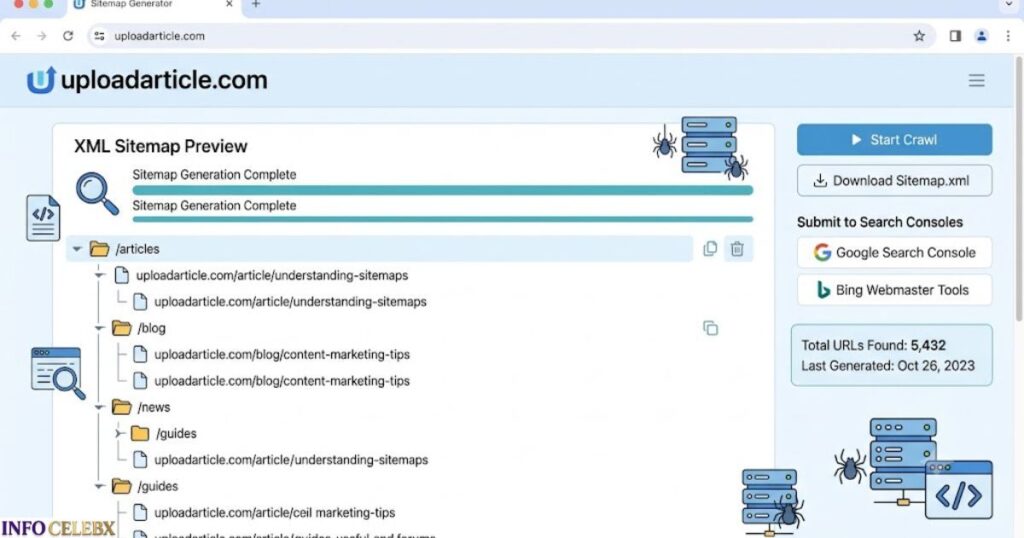
Snapshot of Sitemap Generator UploadArticle.com
| Attribute | Detail |
| Tool type | Online XML/HTML/image sitemap generator |
| Primary use case | Creating, validating, and exporting sitemaps for search engine submission |
| Output formats | XML sitemap, sitemap index file, HTML sitemap, image/video sitemap entries |
| Typical input methods | Live URL crawl, CSV upload, manual URL list, CMS export |
| Best suited for | Bloggers, e-commerce stores, agencies, developers, multi-platform site owners |
| Works alongside | Robots.txt, Google Search Console, Bing Webmaster Tools, CMS plugins |
What Is Sitemap Generator UploadArticle.com?
At its core, Sitemap Generator UploadArticle.com is a utility that scans a website’s structure and produces a machine-readable file listing every page you want search engines to know about. Rather than manually writing XML markup for every blog post, product page, or category, the tool crawls a site or accepts a list of URLs and outputs a properly formatted sitemap, ready to upload and submit to search engines.
What separates a dedicated generator from doing this by hand is consistency. A hand-coded sitemap is prone to typos, unclosed tags, or stale timestamps that never get updated. An automated generator applies the same formatting rules every single time, which matters more than it sounds like it should, because search engines are unforgiving about malformed XML—a single broken tag can cause an entire file to be rejected rather than just the one bad entry.
It’s also worth being clear about what the tool is not. It isn’t a ranking tool, a content optimizer, or a substitute for good internal linking. It does one job — mapping a site’s structure into a format machines can read quickly — and it does that job so the rest of an SEO strategy has a fair chance to work.
Who Should Use This Tool?
Not every website has the same sitemap needs, but very few have none at all. Bloggers and content publishers benefit because new articles often need to be discovered quickly, and accurate timestamps tell search engines exactly when something changed. E-commerce store owners benefit even more since catalogs change constantly—items go out of stock, prices shift, and new arrivals need to be crawled before a competitor’s near-identical listing claims the visibility first.
Developers and agencies managing several client sites typically use a generator for speed: rather than writing a custom script for every project, a generator standardizes the process across dozens of sites running different platforms, including WordPress, Drupal, Joomla, Blogger, and increasingly modern JavaScript-driven sites built with React or Vue or deployed through static hosts like Netlify. Even hobby sites and portfolios benefit, since a sitemap is one of the few foundational SEO tasks that takes minutes to set up and keeps paying off for the life of the site.
Related Read: Tristyn Kalama Net Worth
Sitemaps Explained: Definition and Role in SEO

A sitemap, in the technical SEO sense, is a structured file—almost always XML—listing the URLs on a website along with optional metadata such as when each page was last modified, how often it tends to change, and its relative priority. It is not a navigation menu for human visitors; it’s a direct line of communication to search engine crawlers like Googlebot and Bingbot.
Search engines discover pages primarily by following links, starting from pages they already know about and crawling outward from there. A sitemap shortcuts that process. Instead of waiting for a crawler to stumble onto a page through internal linking, a sitemap hands it a complete inventory upfront. This matters most for pages that are newly published, weakly linked internally, or buried several clicks deep in a site’s architecture, where organic discovery through crawling alone could otherwise take far longer.
Why Every Website Needs a Sitemap
It’s a common misconception that small websites don’t need a sitemap because search engines will “find everything anyway.” In practice, even modest sites benefit because crawlers allocate limited time and resources to each domain—a concept known as “crawl budget.” Without a sitemap, that budget can be spent inefficiently: crawling outdated pages, getting stuck in pagination loops, or missing newer content entirely.
Larger sites have an even stronger case. A site with thousands of product pages, blog posts, or location pages cannot rely on internal linking alone to surface everything to a crawler within a reasonable timeframe. Sites that have recently changed domains, restructured URLs, or migrated platforms benefit especially from a fresh sitemap, since it helps search engines quickly re-map the new structure instead of continuing to crawl outdated paths that no longer exist.
Key Features of Sitemap Generator UploadArticle.com:
A reliable sitemap tool earns its place in an SEO workflow through a handful of practical capabilities:
- Automatic crawling of a website’s URL structure to detect pages, posts, categories, and media files without manual entry.
- CSV or bulk URL import for sites that already maintain a structured list of pages outside a live crawl.
- Support for generating a sitemap index file once a site exceeds the URL limits of a single sitemap.
- Custom filtering to include or exclude specific URL patterns, such as admin pages, tag archives, or duplicate parameter-based URLs.
- Accurate lastmod timestamp generation based on actual content modification dates rather than the date the sitemap was created.
- Export in XML (for search engines), HTML (for human visitors), and image/video-specific sitemap formats.
- Built-in validation that flags malformed entries, encoding issues, or URLs returning errors before submission.
Types of Sitemaps
Not all sitemaps serve the same purpose, and knowing the differences helps you pick the right one for your situation.
XML sitemaps are the standard format read by search engine crawlers. They’re not meant for human visitors and contain structured data like URLs, last-modified dates, and change-frequency hints.
HTML sitemaps, by contrast, are built for people. They appear as an actual page on the site, often linked in the footer, giving visitors a clickable overview of the site’s structure while quietly adding another layer of internal linking.
Image and video sitemaps are a more specialized format that helps search engines discover media that might not otherwise be crawled efficiently, such as images loaded dynamically through JavaScript or video content hosted on a separate media server. For visually heavy sites like photography portfolios or e-commerce catalogs, these can meaningfully improve visibility in image search results.
Sitemap index files come into play once a site grows beyond what a single sitemap file can hold. Instead of cramming every URL into one document, the index file acts as a directory pointing to multiple smaller sitemap files, typically organized by content type, such as separate sitemaps for posts, pages, products, and images.
The distinction between dynamic and static sitemaps comes down to how the file is generated. A static sitemap is created once and manually updated, which works fine for a small, rarely changing site but quickly becomes outdated for anything more active. A dynamic sitemap regenerates automatically whenever content changes, which is the standard for blogs, news sites, and stores publishing new pages regularly.
Similarly, manual versus automatic generation is a question of maintenance effort. Hand-building a sitemap might make sense for a five-page brochure site, but beyond that, automated generation through a tool, CMS plugin, or build-time script removes the risk of forgetting to update it after every change.
What Goes Inside an XML Sitemap
A well-formed XML sitemap entry typically includes four pieces of information: the URL itself, the date it was last modified, how frequently it’s expected to change, and a priority value indicating its relative importance compared to other pages on the site. In practice, major search engines have stated they largely disregard the priority and change-frequency fields, relying instead on their own crawling signals, but they still respect the URL and lastmod date as useful hints, particularly for surfacing recently updated content faster.
The lastmod tag deserves special attention, since it’s one of the few fields crawlers actually trust. It should reflect the real date a page’s content meaningfully changed—not the date the sitemap regenerated and not a timestamp bumped automatically every refresh cycle. Search engines have grown skeptical of sites that update lastmod dates without making genuine content changes, since it’s occasionally used as a manipulation tactic to fake freshness signals.
There’s ongoing debate about whether canonical URLs should be the only URLs listed in a sitemap. The general consensus, and the recommendation from major search engines, is yes: a sitemap should contain only the canonical version of each page. Including non-canonical duplicates sends mixed signals about which version of a page should actually rank.
The same logic extends to noindex pages. A page marked “noindex” is explicitly telling search engines not to show it in results, so including it in a sitemap creates a contradiction—asking crawlers to visit a page you’ve also told them to ignore. Most technical SEO guidance recommends keeping noindex pages out of sitemaps entirely to avoid sending conflicting signals.
Finally, every URL listed should consistently use HTTPS rather than HTTP, assuming the site has SSL configured, which the overwhelming majority of modern sites do. Listing HTTP versions of pages that simply redirect to HTTPS adds unnecessary redirect hops for crawlers and can muddy canonicalization signals unnecessarily.
Sitemap Size and Technical Limits to Know
Sitemaps follow a published protocol with hard technical limits. Exceeding them doesn’t necessarily break a site, but it can cause a sitemap to be partially ignored or rejected outright.
| Limit | Specification | Why It Matters |
| Maximum URLs per sitemap file | 50,000 | Prevents oversized files that crawlers may refuse to fully process |
| Maximum file size (uncompressed) | 50 MB | Keeps parsing fast and reliable for crawler infrastructure |
| File encoding | UTF-8 | Ensures special characters and non-Latin URLs render correctly |
| Special characters | Must be escaped (e.g., “&” becomes “&”) | Prevents the XML file from being invalid or unreadable |
| Sitemap index file limit | Up to 50,000 referenced sitemap files | Allows very large sites to scale beyond a single file |
| URL scope rule | A sitemap can only list URLs within its own directory level or below | Prevents a sitemap from making claims about URLs it doesn’t control |
| Date format for lastmod | W3C Datetime format (ISO 8601) | Standardizes how crawlers interpret modification dates |
That URL scope rule trips up more people than it should: a sitemap hosted at example.com/blog/sitemap.xml can only legitimately list URLs beginning with example.com/blog/. If a sitemap needs to cover an entire domain, it generally needs to sit at the root level instead.
How to Create, Place, and Submit Your Sitemap
Generating the file is only half the job — placement and submission matter just as much. The conventional and most widely recognized location for a sitemap is a website’s root directory, accessible at a predictable address like example.com/sitemap.xml. Search engines and many automated tools check this location by default, even before explicit submission happens.
For sites that already track their own page inventory, importing a CSV list of URLs is often faster than relying on a live crawl, particularly for staging environments or sites with crawl restrictions. Once the file is generated, two things should happen.
First, the sitemap’s location should be referenced inside the site’s robots.txt file using a simple Sitemap: directive pointing to its full URL, giving any crawler reading robots.txt—which is nearly all of them—an immediate pointer without needing to guess. Second, the sitemap should be submitted directly through Google Search Console and Bing Webmaster Tools, which not only registers it but provides ongoing feedback on how many submitted URLs were actually indexed versus excluded, which is invaluable for diagnosing problems later.
Related Read: Tristyn Kalama Age
Generating Sitemaps Across Different Platforms

Sitemap generation looks slightly different depending on what a site is built on, and understanding those differences avoids a lot of wasted troubleshooting time.
On WordPress, sitemaps are typically handled through SEO plugins that auto-generate and update the file whenever content is published, though a standalone generator is still useful for auditing what those plugins produce or for sites running multiple plugins with overlapping sitemap features.
Drupal and Joomla both offer dedicated sitemap modules, but because their URL structures are more configurable than WordPress’s, a generator that crawls the live site tends to catch edge cases that a module relying on internal database structure might miss.
Blogger (Blogspot) sites have a more limited native sitemap format, often capped at a small number of recent posts, which is why many Blogger users turn to an external generator to produce a more complete file covering their full archive.
For sites built with modern frameworks like React or Vue or deployed through static hosts like Netlify, sitemap generation often happens at build time through a script or plugin integrated into the deployment pipeline, since these sites don’t always have a traditional server-side CMS generating pages dynamically. In these cases, a generator that can crawl the final rendered output — rather than the source code — produces a more accurate result.
API Access and Automated Sitemap Generation
For developers managing sitemap generation programmatically rather than through a manual interface, API access allows sitemap creation to be triggered automatically as part of a content publishing workflow, a scheduled job, or a continuous integration pipeline. A typical setup involves authenticating with an API key, submitting a site URL or a structured JSON payload of pages, and receiving a generated sitemap file in return, which can then be deployed directly to a server without manual intervention.
This kind of automation matters most for high-frequency publishers — news sites, large marketplaces, or platforms where content volume makes manual regeneration impractical. Combined with version control workflows common among development teams, an API-driven approach also makes it easier to track changes to a sitemap over time and catch unintended regressions, such as an accidental bulk removal of URLs, before they affect live search visibility.
How Sitemaps Boost Crawl Budget and Indexing Speed
Crawl budget is best understood as the amount of attention a search engine is willing to give a site within a given timeframe, based on factors like the site’s authority, server response speed, and how often its content changes. It isn’t unlimited, and large sites in particular can waste a significant share of it crawling low-value pages, redirect chains, or duplicate content if left unmanaged.
A clean, accurate sitemap helps direct that limited attention toward the pages that matter most. Rather than a crawler spending its budget rediscovering the same handful of well-linked pages, it gets a direct list of everything worth visiting, including pages that might otherwise sit several clicks deep in the site’s architecture.
This also affects indexing timelines. While a sitemap doesn’t guarantee instant indexing, sites that submit accurate, well-structured sitemaps tend to see new content discovered noticeably faster than sites relying purely on organic crawl discovery—sometimes within hours rather than days or weeks, particularly for established domains with a strong crawl history.
Sitemaps also play a role in mobile-first indexing, which is how the majority of the web has been indexed for years now. Since the mobile version of a page is treated as the primary version for indexing purposes, sitemaps should reflect URLs that resolve correctly on mobile, and any separate mobile-specific URLs should be clearly distinguished if a site still uses that older pattern.
Sitemap vs Robots.txt
These two files are often confused because they sit in the same technical neighborhood, but they do almost opposite jobs. A sitemap is an invitation—it tells search engines which pages a site owner wants found and crawled. Robots.txt, by contrast, is a set of restrictions — it tells crawlers which sections of a site they’re not allowed to access at all.
They also interact in one important way: robots.txt is commonly used to point to the sitemap’s location, even though the two files otherwise serve unrelated purposes. A site can have a perfectly valid sitemap and a robots.txt file that blocks crawling of unrelated directories, and both can coexist without conflict, as long as the sitemap doesn’t list URLs that robots.txt explicitly disallows, since that would create a contradictory signal.
Common Sitemap Mistakes and Errors to Avoid
Several recurring issues account for the vast majority of sitemap-related indexing problems. Including URLs that return 404 errors or redirect elsewhere wastes crawl budget on dead ends. Listing pages blocked by robots.txt or marked noindex creates the contradiction discussed earlier. Forgetting to update the sitemap after a site migration or URL restructuring leaves crawlers working from outdated information.
Mixing HTTP and HTTPS versions of the same URLs, or including both www and non-www variants without proper canonicalization, splits signals that should be unified into one. And perhaps most commonly, sites simply forget the sitemap exists after initial setup, letting it silently drift out of sync with the live site for months or even years.
Why Your Pages Might Not Be Getting Indexed
A sitemap can’t force indexing on its own, and there are several reasons a submitted page might still be excluded from search results. Thin or low-value content is one of the most common culprits—if a page doesn’t offer enough unique substance, a search engine may choose not to index it even after crawling it successfully. Duplicate content, where a page closely mirrors another already-indexed page, often gets filtered out in favor of the canonical version.
Technical blockers like accidental noindex tags, robots.txt restrictions, or server errors during a crawl attempt can prevent indexing entirely. And newer domains or pages with very little internal or external linking sometimes simply haven’t accumulated enough trust signals yet, even when everything else is technically correct.
Advanced SEO Strategies With Sitemap Generator UploadArticle.com

Beyond the basics, sitemaps can support broader strategic goals. Organizing sitemap files by content category — separating blog posts, product pages, and images into their own indexed sitemaps — makes it far easier to diagnose indexing issues at a granular level rather than guessing across one massive file. This structure also supports topical authority building, where clusters of related content are clearly grouped and easily discoverable together, reinforcing to search engines that a site has genuine depth on a subject rather than scattered, unrelated pages.
Sitemaps also indirectly support E-E-A-T signals — experience, expertise, authoritativeness, and trustworthiness — not by containing those signals themselves, but by ensuring high-quality, authoritative content actually gets crawled and indexed in the first place. Excellent content that never gets discovered can’t contribute to a site’s perceived expertise, so the sitemap functions as the delivery mechanism that lets the content’s quality actually count toward those signals.
One advanced principle worth internalizing: sitemap quality matters more than quantity. A sitemap stuffed with thousands of thin, near-duplicate, or low-value URLs doesn’t help rankings—it can actively dilute crawl efficiency and signal a less curated site overall. A smaller, carefully maintained sitemap containing only genuinely valuable, indexable pages tends to outperform a bloated one in practice.
Does a Sitemap Guarantee Rankings or Better CTR?
This is worth addressing directly because it’s one of the most persistent misunderstandings in technical SEO: a sitemap does not influence rankings, and it does not directly affect click-through rate. It has no bearing on keyword relevance, backlink profile, content quality, or any of the actual ranking factors search engines weigh when deciding where a page appears in results.
What a sitemap does is far more foundational — it improves the odds that a page gets discovered and crawled in the first place. Think of it less as a ranking lever and more as a discovery tool. A page can’t rank if it was never indexed, and a sitemap reduces the chances of that happening due to poor internal linking or crawl inefficiency. But once a page is indexed, everything from that point forward—its rank position, its appearance in search snippets, its CTR—depends entirely on factors that have nothing to do with the sitemap itself.
Sitemap Generator UploadArticle.com vs Other Sitemap Tools
| Factor | Sitemap Generator UploadArticle.com | CMS Built-In Plugins (e.g., WordPress SEO plugins) | Manual/Custom Scripts |
| Ease of setup | Fast, no coding required | Fast, but tied to a specific CMS | Slow, requires development time |
| Platform flexibility | Works across multiple platforms and URL sources | Limited to the CMS it’s built for | Fully flexible but high maintenance |
| Auto-updating | Supports regeneration on content changes | Usually automatic within the CMS | Requires manual scripting for automation |
| Filtering and exclusions | Customizable URL filtering | Often limited to basic include/exclude rules | Fully customizable but manually coded |
| API/automation support | Available for developer workflows | Rare outside enterprise plugins | Fully custom, but built from scratch |
| Best fit | Multi-platform sites, agencies, non-developers | Single-CMS websites already using the plugin | Highly custom or large-scale technical setups |
Real SEO Case Study
Consider a mid-sized content publisher that had quietly accumulated several hundred blog posts over a few years without ever submitting a sitemap. Many older articles, despite solid content, had almost no internal links pointing to them and had never been crawled. After generating a clean sitemap, filtering out outdated tag-archive pages and broken URLs, and submitting it through Search Console, the publisher began seeing previously invisible articles get crawled and indexed within days. The lesson wasn’t that the sitemap caused new rankings — it was that years of genuinely good content had simply never been given the chance to be found. The sitemap closed that gap.
Sitemap Optimization Checklist and Pro Tips
- Confirm the sitemap only includes canonical, indexable URLs—no duplicates, no noindex pages, and no broken links.
- Keep lastmod timestamps accurate and tied to real content changes, not automatic refresh dates.
- Split large sites into a sitemap index file organized by content type rather than one massive file.
- Reference the sitemap’s location inside robots.txt and submit it directly through Search Console and Bing Webmaster Tools.
- Regenerate or resubmit the sitemap after any major site migration, redesign, or URL restructuring.
- Periodically audit the sitemap against actual crawl and indexing reports to catch drift between what’s listed and what’s truly indexable.
- For JavaScript-heavy or static-site builds, generate the sitemap from the final rendered output rather than the source files.
- Resist the urge to include every possible URL—prioritize pages that offer genuine value over sheer volume.
The Future of Sitemap SEO Beyond 2026
As search engines lean further into AI-assisted crawling and content understanding, sitemaps are likely to remain relevant for a simple reason: even sophisticated crawlers still benefit from an efficient, structured map of a site rather than relying solely on inference. What’s changing is the emphasis—less on generating massive sitemaps for the sake of completeness and more on curated, accurately maintained sitemaps that reflect genuinely valuable content. Expect continued integration between sitemap data and structured data markup, tighter API-driven automation for high-volume publishers, and stronger feedback loops through tools like Search Console that reward sites maintaining clean, well-organized sitemap structures over time.
Related Read: Tristyn Kalama Biography
Related SEO Keywords for Better Optimization
To round out the topical coverage of this guide, here are semantically related terms worth understanding alongside sitemap generation: XML sitemap protocol, sitemap index file, crawl budget optimization, Googlebot crawling behavior, canonical URL, noindex directive, robots.txt directive, lastmod tag, mobile-first indexing, structured data markup, technical SEO audit, orphan pages, crawl efficiency, indexing status report, image and video sitemaps, CSV-based URL import, sitemap API automation, and CMS-specific sitemap generation across WordPress, Drupal, Joomla, Blogger, and JavaScript frameworks such as React, Vue, and static hosts like Netlify.
FAQ’s About Sitemap Generator UploadArticle.com
What is Sitemap Generator UploadArticle.com used for?
It’s used to automatically create XML, HTML, and image/video sitemaps that list a website’s pages so search engines can discover and crawl them more efficiently.
Does a sitemap improve Google rankings?
No, not directly. A sitemap helps pages get discovered and indexed, but ranking position depends on content quality, relevance, and other established ranking factors.
How often should I update my sitemap?
Ideally, the sitemap should update automatically whenever content is added, changed, or removed, rather than being manually refreshed on a fixed schedule.
Can Google find pages without a sitemap?
Yes, through internal and external links, but discovery can be slower and less reliable, especially for large sites or poorly linked pages.
Should every page be included in a sitemap?
No. Only canonical, indexable, high-value pages should be included—noindex pages, duplicates, and broken URLs should be left out.
Is it safe to use an online sitemap generator?
Generally yes, as long as the tool only reads a site’s public URL structure and doesn’t request unnecessary credentials. Reviewing what data a tool collects before connecting it to a live site is good practice regardless of which generator is used.
Conclusion About Sitemap Generator UploadArticle.com
A sitemap will never be the flashiest part of an SEO strategy, but it remains one of the most dependable. Sitemap Generator UploadArticle.com simplifies a task that’s easy to get wrong by hand and easy to forget about once it’s set up—and getting it right means search engines spend their limited attention on the pages that actually deserve it. Pair a clean, accurate sitemap with genuinely strong content, and you’ve removed one of the few barriers standing between good work and the audience that should be finding it.

My name is Sohaib Khan, and I’m an SEO expert with 3 years of experience in improving website rankings, increasing organic traffic, and optimizing content for search engines. I specialize in keyword research, on-page SEO, technical SEO, and content strategy to help businesses grow their online presence and achieve better search visibility.